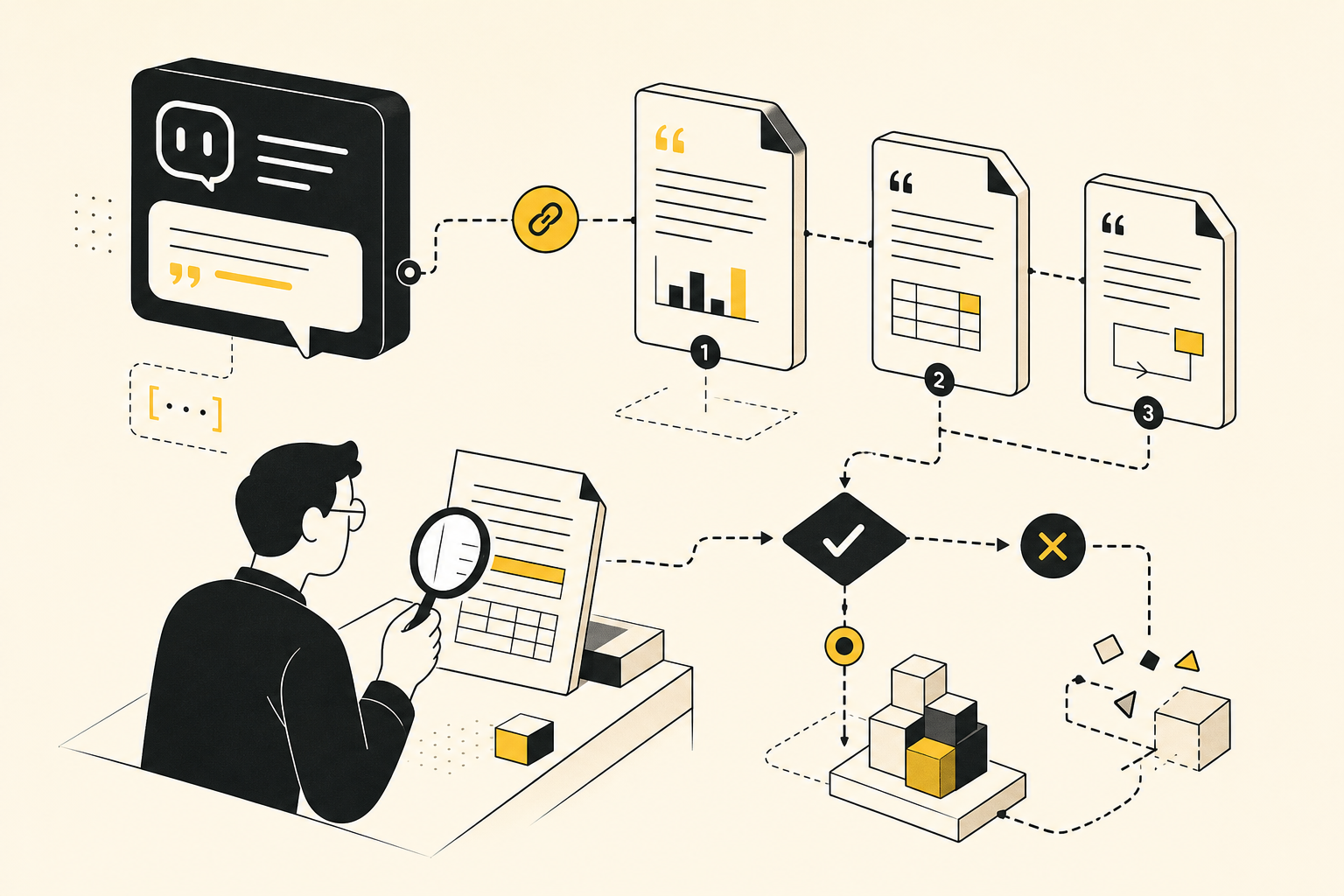
A citation is a pointer to a source, not a verdict on an AI answer. The link may open correctly and lead to a relevant document while supporting only part of what the assistant says.
For a small business, that difference matters. An assistant might cite a returns policy when answering a customer question, but the policy may support the return window and say nothing about the refund method the assistant also promises. To assess the answer, check the evidence against each claim—not just the link.
Four checks, four different questions
When reviewing a cited answer, separate four questions that are easy to blur together:
1. Does the citation work? Does it open, and does it lead to the intended source? 2. Does the source support the claim? Can you find a passage that backs the specific statement? 3. Does the answer cover the question? Has it addressed all the important parts, including limits or exceptions? 4. Is the source trustworthy for this purpose? Is it authoritative, relevant, and current enough to rely on?
Passing one check does not mean passing the others. A link can work while pointing to an unrelated page. A relevant policy can support one sentence but not another. A well-supported answer can still leave out an important exception. And even a passage that clearly supports a claim may come from an outdated or unofficial document.
This is why “grounded” should be read narrowly. In AI evaluation, groundedness generally concerns whether an answer is supported by the context provided to the model. Microsoft’s RAG evaluation guidance treats groundedness and completeness as separate measures: an answer can stick to its context but still fail to address the whole question. Neither measure, by itself, establishes that the underlying source is authoritative or correct.
Check the claim, not the paragraph
Consider a hypothetical customer question: “Can I return an item, and when will I get my money back?”
The assistant replies: “You can return unused items within 30 days with a receipt, and your refund will be issued to your original payment method. Final-sale items are excluded.”
Suppose the citation opens the company’s returns policy. The policy says unused items can be returned within 30 days with a receipt. It does not mention the refund method or final-sale items.
The citation is real and relevant, but it does not support the whole answer. The first claim is supported. The second and third are unsupported by the cited passage. That does not prove they are false; they may appear in another source. But until the assistant provides that evidence, a reader should not treat them as verified.
The key is to split a sentence into claims small enough to check. In this example, ask separately:
- Can unused items be returned?
- Is the return window 30 days?
- Is a receipt required?
- Does the refund go to the original payment method?
- Are final-sale items excluded?
A single citation might support all five, some of them, or none. Do not let a citation attached to the end of a paragraph stand in for evidence for every statement in it.
A simple claim-by-claim review
You do not need a special evaluation platform to begin checking an assistant’s answers. For a sample answer, make a short record with one row per factual claim:
| Claim | Citation opens and points to the right source? | Passage supports the claim? | Review | |---|---|---|---| | Unused items can be returned within 30 days | Yes | Yes | Supported | | A receipt is required | Yes | Yes | Supported | | Refund goes to the original payment method | Yes | No passage found | Unsupported by this citation | | Final-sale items are excluded | Yes | No passage found | Unsupported by this citation |
Use four review labels:
- Supported: The cited passage clearly backs the claim.
- Partly supported: It backs only some of the details, or the answer goes further than the passage.
- Unsupported: You cannot find evidence for the claim in the cited source.
- Not checked: You have not inspected the passage, or the citation is unavailable.
“Unsupported” is a statement about the evidence you checked, not proof that the claim is false. It may be supported elsewhere. The useful next step is to ask the assistant for a citation to that other source, or check the relevant company document directly.
When inspecting a passage, compare the exact wording and scope. Does it cover the same product, customer type, location, date, and conditions? A source saying “eligible orders may be refunded” does not necessarily support a promise that every customer will receive a refund. Watch for absolute words such as always, all, and guaranteed when the source uses qualified language.
Support is not the same as completeness
A cited answer can be fully supported and still be a poor answer. If someone asks about both eligibility and timing, an answer that accurately covers eligibility but omits timing may be grounded yet incomplete.
To check completeness, break the question into its parts before judging the answer. For “Can I return this item, and when will I get my money back?”, the parts include whether the item is eligible, what conditions apply, and what happens after the return. Then check whether the answer addresses each part or clearly says when information is missing.
This distinction helps diagnose different failures. If the assistant invents a refund method, that is a support problem. If it gives an accurate return window but ignores the refund question, that is a completeness problem. The fixes may differ: one calls for better evidence or less confident wording; the other may call for a clearer answer structure.
Test a small set of real questions
A small team can learn a lot by reviewing a manageable set of questions that reflect how people actually use the assistant. Include ordinary questions, questions with multiple parts, ambiguous questions, and questions the documents cannot answer.
For each answer, record the question, the claims that matter, whether the citations open, what passages support which claims, and any missing parts. Avoid saving unnecessary customer details; use representative questions without personal information when possible.
Look for patterns rather than treating one answer as a verdict on the whole assistant. Does it often cite a broad document instead of the relevant passage? Does it add conditions not found in the source? Does it answer questions that the available material cannot resolve? These observations can guide changes to the assistant’s instructions, source material, or review process. After a meaningful change, repeat the same questions so you can see whether the specific failures improved.
The ALCE research paper evaluated systems that retrieve evidence and generate cited answers. On its ELI5 benchmark, the authors reported that even the best tested models lacked complete citation support 50% of the time. That result shows why citation support deserves its own check in that benchmark setting; it is not a failure rate for every business assistant or document collection.
What automated checks can—and cannot—tell you
Some platforms provide grounding checks or scores that compare answer claims with supplied passages. Google’s documentation describes checks that connect claims in an answer to supporting passages. Such tools can help a team prioritize answers for review, but the score’s meaning depends on the platform and its method. Check the platform’s documentation rather than assuming that a high score means the answer is correct.
A support check also cannot, on its own, tell you whether the source is the right authority, whether it is still valid, or whether it is accurate. A passage from an old draft may support the assistant’s wording perfectly while still being the wrong basis for a current customer commitment. Research on citation evaluation likewise argues for considering qualities beyond support, such as source credibility and usefulness.
Treat citations as an invitation to inspect the evidence. For low-risk questions, a clear passage may be enough for a quick review. For answers that affect money, eligibility, safety, or contractual commitments, check the source and relevant qualifications before acting. The practical rule is simple: verify each important claim against its passage, then ask separately whether the answer is complete and the source deserves to be trusted.