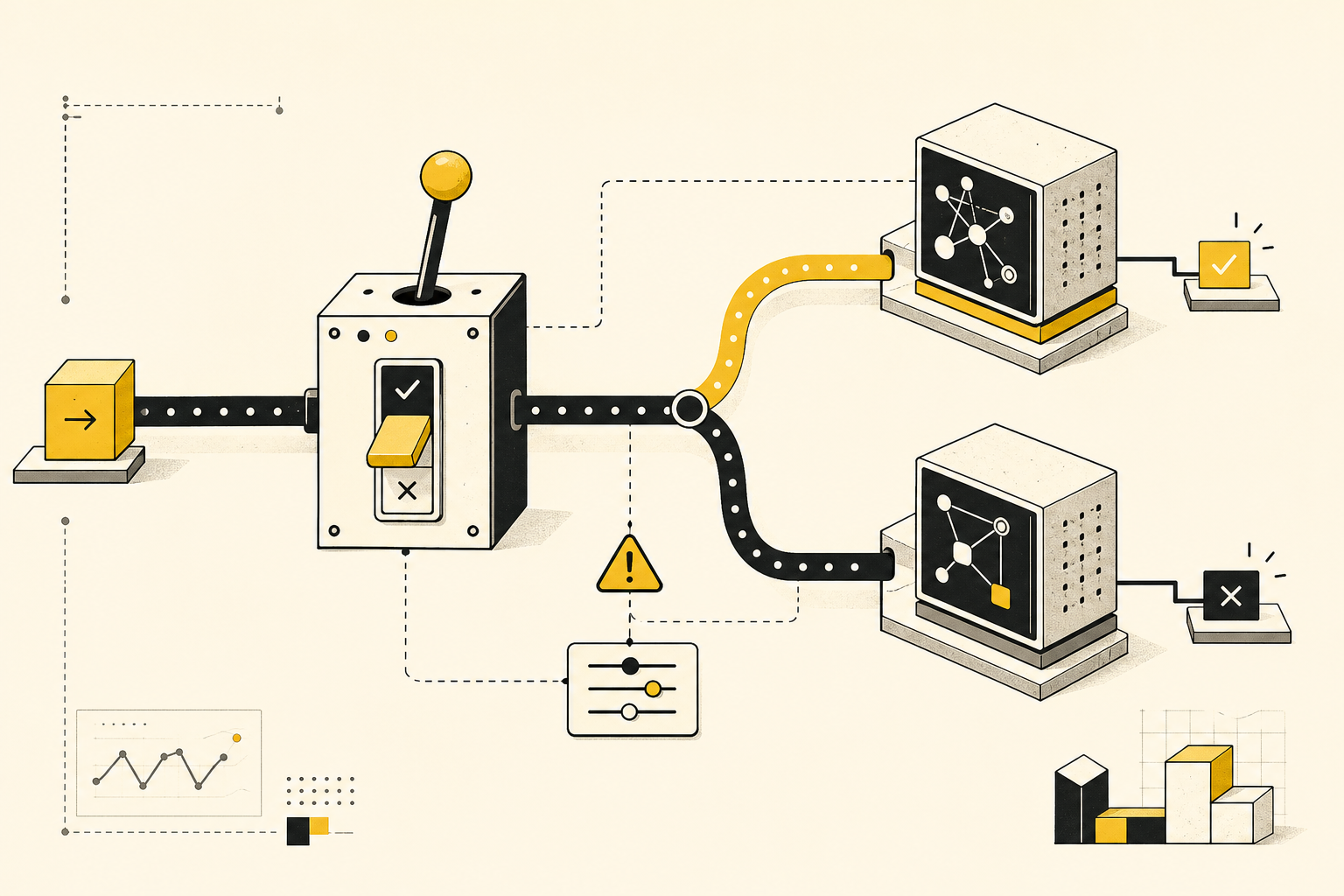
A promise that customer data is “not used to train models” does not mean the data is never stored. It means something narrower: the provider says it will not use that data to improve or train its models under the terms that apply to your account and service.
That is an important assurance, but it does not answer how long prompts and responses are kept, whether a particular AI feature stores information to work, or what your own app and connected tools record. Before sending customer information to an AI service, follow the data through all of those places—not just the model.
What does “not used for training” mean?
Model training is the process of using examples to change or improve a model’s behavior. A provider’s training policy tells you whether the content you send may be used for that purpose. It does not, on its own, tell you what happens to the content after a request is processed.
Keep four questions separate:
1. Model training: Can the provider use the content to train or improve models? 2. Provider retention: Does the provider keep prompts, responses, or related records after processing, and for what reason? 3. AI-feature storage: Does the specific feature save data as part of its operation, such as maintaining a conversation or handling uploaded files? 4. Your own records: Does your product, platform, or any connected service keep a copy in logs, databases, analytics, support tools, or backups?
These are distinct parts of the data path. A “no training” answer addresses the first. It is not a substitute for answers to the other three.
Can an AI API retain data even if it does not train on it?
Yes. Training and retention are different activities. A provider may say that API content is not used to train models while also retaining some information for a separate purpose or for a period defined by its product terms.
Provider documentation offers useful examples, but not universal rules. OpenAI’s API documentation separates training use from abuse-monitoring logs and from application-state retention for some features. Anthropic’s commercial API documentation describes a default deletion period for inputs and outputs, with stated exceptions and other arrangements. Google Cloud documents both a restriction on training use without permission or instruction and feature-specific retention scenarios. These policies apply to particular services and conditions; they should not be generalized to every AI provider or every way of using a product.
The practical lesson is to ask two questions, not one: Will this data be used for training? And what data may be retained, where, and for how long?
Follow a customer message through an AI workflow
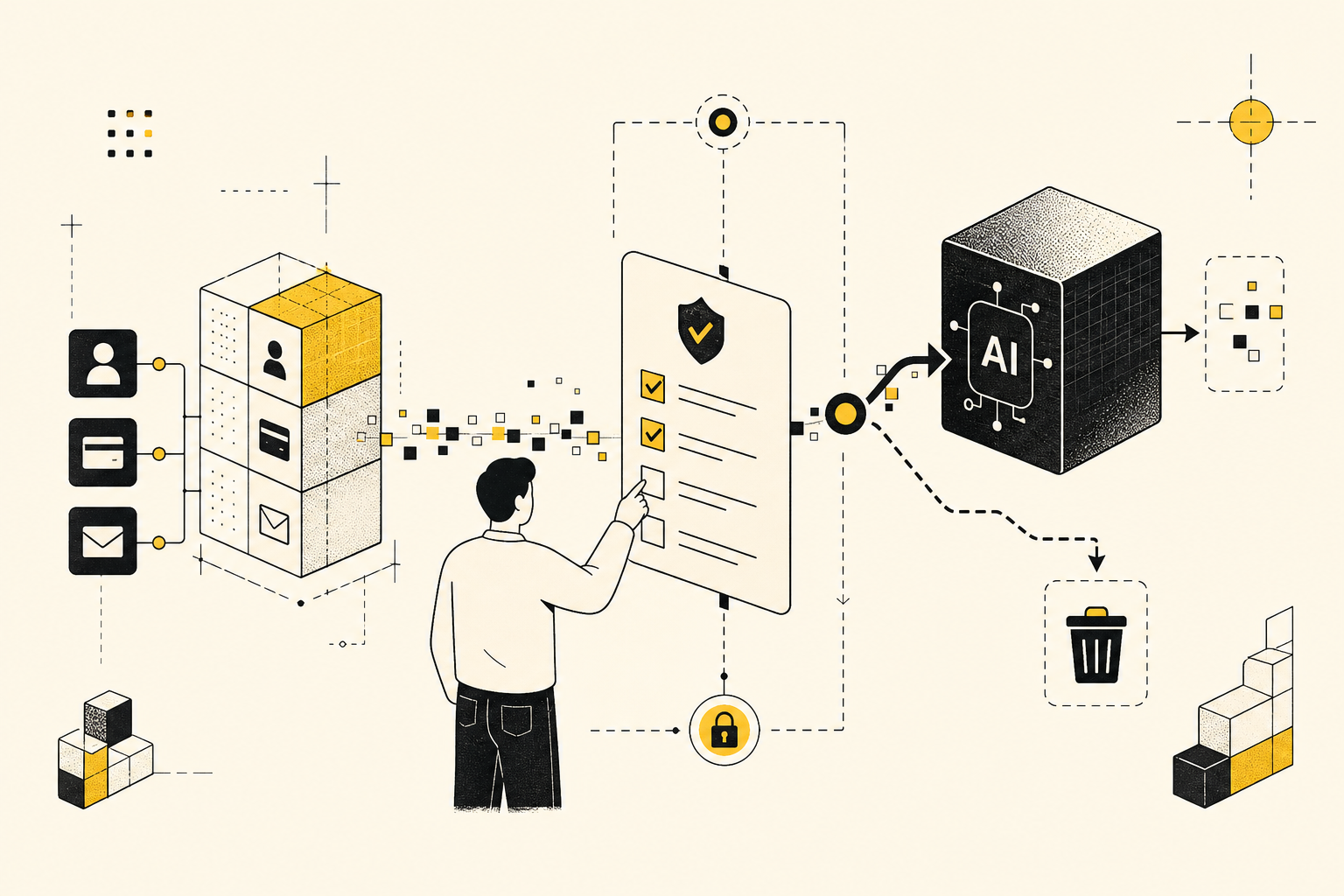
Imagine a customer sends your business a message asking about an order. Your app sends the message to an AI service to draft a reply, then displays the draft to a staff member.
The message may pass through more than one system:
- Your product receives and stores the original message.
- Your app sends some or all of it to an AI provider.
- The provider processes the request and may retain information according to the applicable service, settings, and terms.
- Your app may save the prompt and generated draft in its own conversation history or operational logs.
- A connected customer-support, analytics, or error-monitoring tool may receive related information too.
This is a map of places to investigate, not a claim that every system stores data in each of these ways. A direct API integration and a packaged AI tool are also different arrangements. If you use an AI-enabled software product, the vendor may be between you and the underlying model provider. The model provider’s policy alone cannot tell you what that software vendor stores or sends elsewhere.
The useful question is not simply, “Does the AI store my data?” It is: Which organization receives which information, for what purpose, under what settings, and what happens to it afterward?
A pre-connection checklist for customer data
Before connecting a customer inbox, document store, or database to an AI feature, get clear answers to the following.
1. What exactly will be sent?
List the information the feature needs to do its job. A prompt might include a full email thread, a customer’s account details, internal notes, or attached documents. Do not assume that the visible question is the only information being sent: the application may add context or retrieve records behind the scenes.
Ask whether you can limit the data to what is necessary. For example, a drafting feature may need the customer’s question and relevant order status, but not every historical note in the customer’s record. The right scope depends on the task; the principle is to avoid sending unrelated information.
2. Who receives it?
Identify each organization or service involved: your software vendor, the AI provider, and any connected services that handle the request or its records. If a vendor uses another provider, ask who that provider is and which terms apply.
“API” describes a way software communicates; it is not, by itself, a retention promise. Similarly, “business plan” does not answer every question about a particular feature, setting, or exception. Read the terms and documentation that apply to the actual product you will use.
3. Is it used for training?
Check the policy for the specific service and account arrangement, and look for any opt-in, setting, or exception that changes the default. Distinguish a statement about model training from statements about monitoring, storage, or feature operation.
If the answer is broad or unclear, ask the vendor to confirm in writing how it applies to your intended use. Do not turn a narrow assurance into a broader claim in your own privacy notice or customer communications.
4. What is retained, why, and for how long?
Look for the types of data kept, the purposes for keeping them, and the stated retention period. Check whether the answer differs by feature or configuration. Also ask what happens when you delete a conversation or close an account: does deletion apply to the provider, the software vendor, your own systems, and connected services, or only to one of them?
Do not treat a setting named “zero retention” as self-explanatory. AWS’s Bedrock documentation, for example, describes configurable retention modes and cautions that `store=false` alone does not guarantee zero data retention for every model. The label or setting needs to be understood in the context of the specific model and configuration.
5. What does your own product keep?
Inspect your application and platform settings, not just the AI provider’s documentation. Find out whether prompts and responses appear in application logs, stored conversation records, analytics, error reports, or support tools. If you use a no-code platform or a packaged AI product, ask its vendor what it records and which connected services receive data.
This is the layer teams can overlook: a provider may have a defined retention policy, while the application that calls it keeps a separate copy. A provider’s deletion process cannot tell you what your own product or another integration retains.
What provider examples can—and cannot—tell you
Official documentation can show that training, provider retention, and feature storage are separate questions. It can also show why one company’s configuration or retention period should not be assumed to apply to another.
It cannot establish how your particular AI-enabled product handles customer data. That depends on the exact service, feature, account terms, settings, and connections in use. Policies and product behavior can change, so recheck the documentation before launch and whenever you change providers, features, or configurations.
This article is a practical data-handling check, not a legal or compliance determination. If your use involves sensitive information or creates significant risk for customers, get advice suited to your situation rather than relying on a general provider statement.
Before connecting customer data, write down the path it takes: what you send, who receives it, what each party may retain, and how deletion works at each step. If you cannot answer those questions, “not used for training” is not yet a complete basis for deciding what data to send.