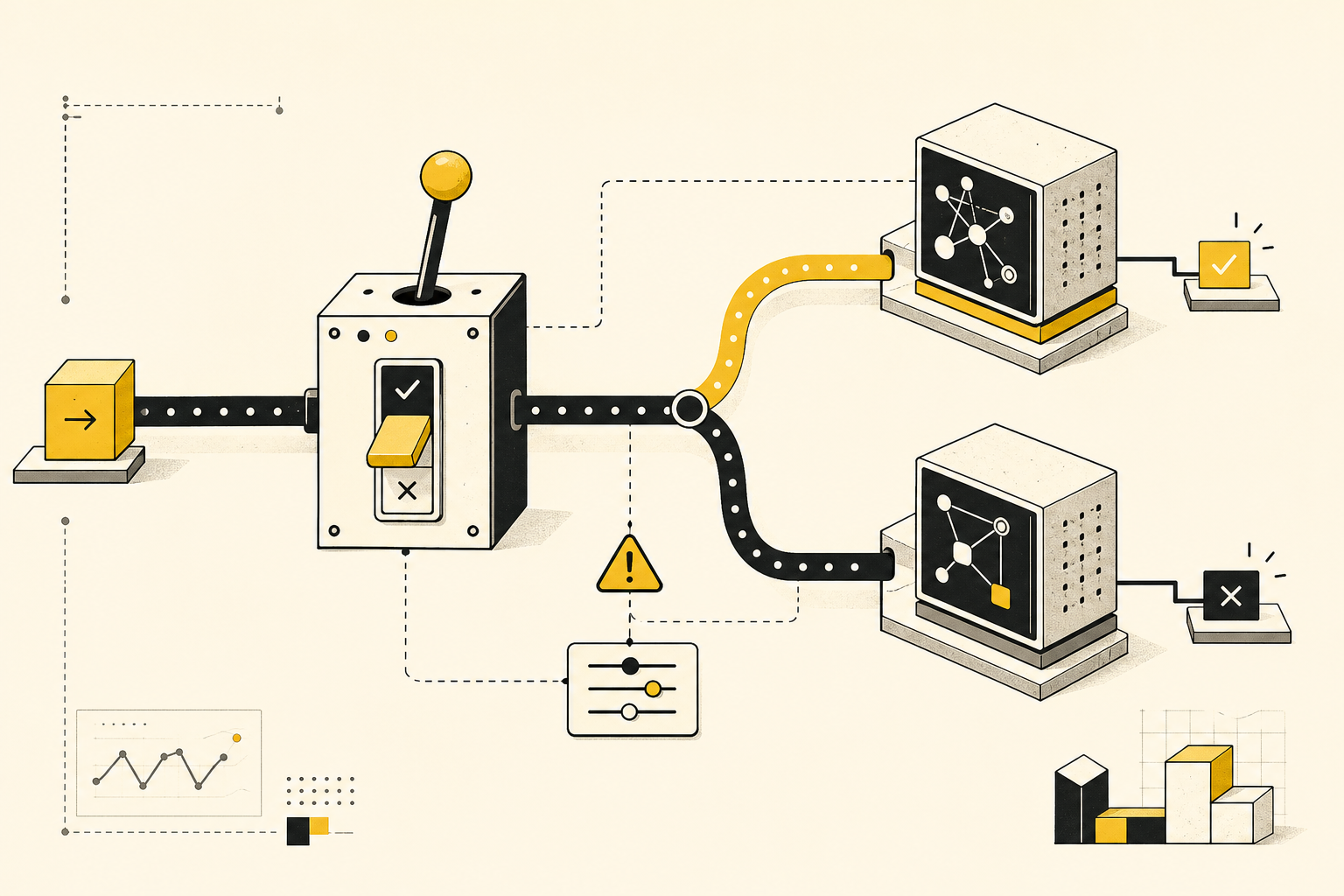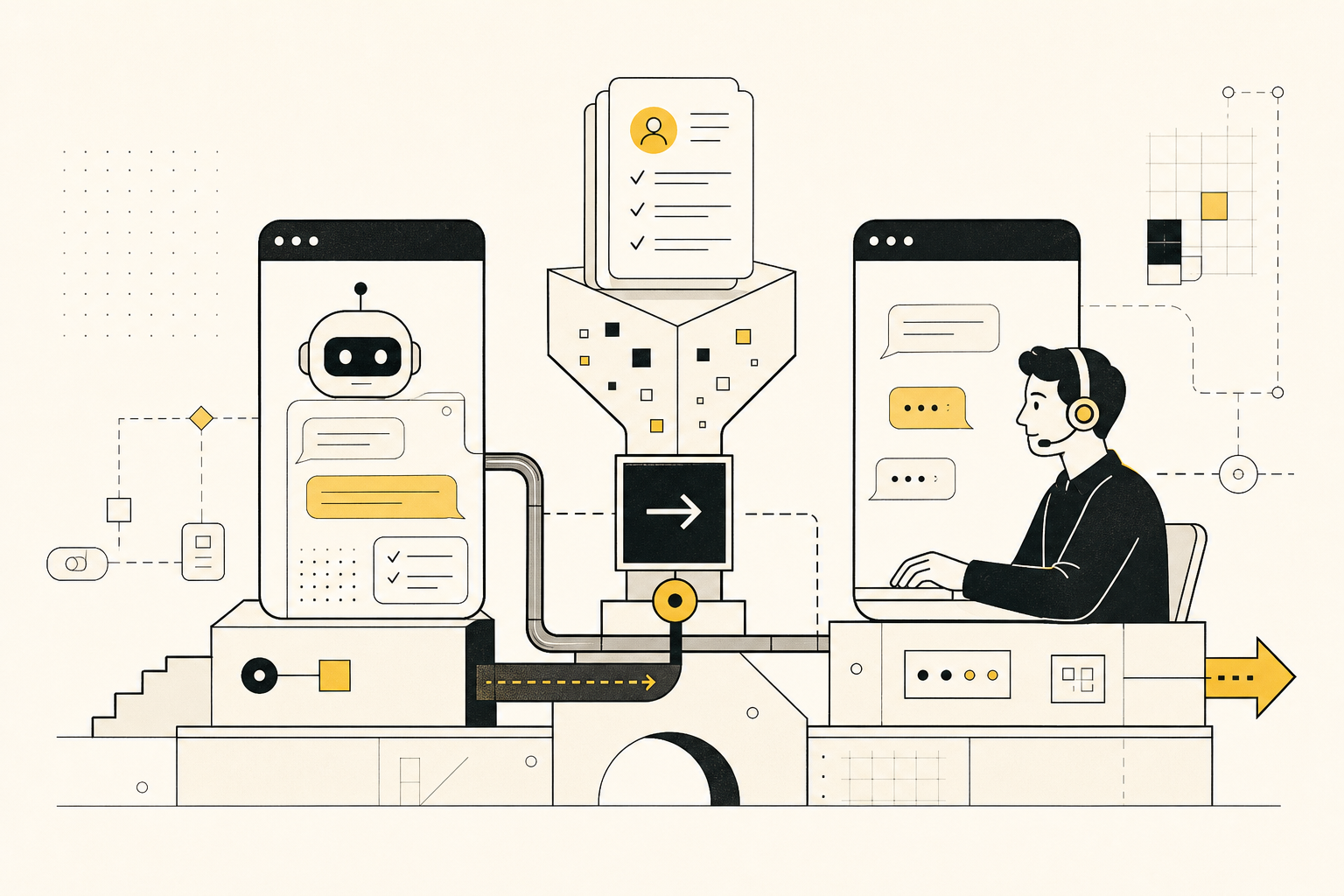
An AI assistant can make the right call to involve a person and still leave the customer stranded. The transfer message appears, but no one receives the conversation. Or a human joins without knowing what the customer asked or what the AI already tried.
A useful handoff is not just a message saying, “I’ll connect you to someone.” It transfers both the conversation context and responsibility for the next response. The customer should have a reasonable path forward, and the human should have enough information to continue helping.
That distinction matters because deciding to escalate and completing a handoff are separate steps. The first determines that the AI should stop handling the issue. The second makes sure the right person can take over without unnecessary rework.
A transfer message is not a completed handoff
Consider a hypothetical support conversation. A customer says a recent order is marked delivered, but it has not arrived. They provide an order number and confirm their delivery address. The AI checks the available information, suggests looking around the delivery area, and asks the customer to confirm that they have done so. The customer confirms, but the order is still missing. The AI cannot resolve the issue and transfers the conversation.
The transfer is complete only if the next step works: the conversation reaches an appropriate person or support queue, the relevant details arrive with it, and the customer knows what to expect. If the AI says a person will take over but the conversation is not routed, the message has not created a handoff. If the conversation is routed but the customer has no idea whether anyone received it, the operational transfer may have happened, but the customer-facing experience is still unclear.
This is a distinct interaction to design. A 2026 peer-reviewed study of text-based customer-service conversations examined how people formulate requests before and after chatbot handover, and how chatbots and human agents use different strategies to repair misunderstandings. It does not tell us how every customer or system will behave, but it supports treating the transition itself—not just the escalation decision—as part of the conversation.
Pass a short, actionable context note
The human taking over needs to know what the customer needs, what has already happened, and what remains unresolved. A concise handoff note can cover:
- The issue: What is the customer trying to get done?
- Relevant details: Which order, account, product, date, or other detail is needed to act?
- What has been tried: What did the AI ask the customer to do, and what happened?
- What remains unresolved: What question or action still needs attention?
- Why the AI handed it over: What limit or complication prevented it from resolving the issue?
For the missing-order example, the note might say: “Customer reports order 1234 is marked delivered but has not arrived. Address confirmed. Customer checked the suggested delivery area; order is still missing. Needs help tracing the delivery or understanding next steps. AI could not resolve with available information.”
That is more useful than “Customer has a delivery problem,” but it should not become a second transcript. The goal is to help the person pick up the task, not to make them read every turn before they can respond.
Summary or transcript: which should the human receive?
A summary and a transcript do different jobs. A summary helps the human orient quickly; a transcript lets them check the original details. When the platform and support process allow it, provide a short summary alongside access to the relevant conversation history. If only one is practical, choose based on the task: a straightforward request may need a clear summary, while a sensitive, disputed, or detail-heavy issue may require the human to inspect the original wording.
Do not treat a summary as guaranteed to preserve every important fact. It can omit a detail, misstate what was tried, or make an uncertain point sound settled. The receiving person should be able to review the conversation when needed, and the handoff note should distinguish customer-provided facts from the AI’s interpretation.
Platform features vary. Microsoft’s Copilot Studio documentation, for example, describes transferring a conversation to a live-agent engagement hub and passing context, including routing-related information. That is an example of what one platform documents—not a capability every AI support product provides. Check whether your own system can pass context, route to the right destination, and keep the conversation history available.
Make ownership and the next step clear
A handoff needs an owner, even if that owner is a team queue rather than a named person. Without one, a request can be transferred in theory but left between systems in practice. Decide what should happen after escalation: where the conversation goes, who is responsible for monitoring it, and what should happen if it cannot be assigned immediately.
The AI’s role after transfer also needs to be clear. If a human has taken over, the AI should not continue sending replies that conflict with the human’s response or make the customer wonder who is helping. Some platforms manage this through conversation states or permissions. Zendesk documents one example in which the live agent becomes the first responder after handoff and the AI agent can no longer respond to that conversation. The details are product-specific, but the underlying design question applies broadly: when does the AI stop, and how does the system show that a person now owns the next response?
Tell the customer what is actually happening. If a person has joined, say so. If the request has been sent to a queue and the customer must wait, explain that instead. Give a response-time estimate only if your staffing and support process can meet it. If no one is available, say what the customer can do next—such as leave a message or return during stated support hours—and whether the conversation will remain available.
Avoid implying that an immediate human response is guaranteed when it is not. A clear, realistic waiting message is better than a reassuring promise the business cannot keep.
Test the complete transition, not just the escalation trigger
A simple test can reveal whether the handoff works without building an elaborate evaluation system. Write a few realistic, multi-turn conversations and run them through the assistant. Include details early in the conversation, a suggested fix, the customer’s response to that fix, and a point where the AI needs to involve a person.
For each test, check:
1. Context: Does the human-facing note preserve the customer’s original issue and the important details they supplied? 2. Previous attempts: Can the human see what the AI asked the customer to try and whether it worked? 3. Routing: Does the conversation reach the intended person or queue? 4. Customer expectations: Is the customer told whether a person has joined, whether they need to wait, and what to do if nobody is available? 5. Ownership: Does the AI stop responding when the human takes over, according to how your system is configured? 6. Continuity: Can the human continue the task, or do they have to ask the customer to explain the whole situation again?
Microsoft’s AI Agent Evaluation Scenario Library includes handoff tests that check whether user-provided details and attempted resolution steps are preserved, and recommends using multi-turn conversations to test context retention. The practical point is straightforward: a handoff that works on a one-line test may fail when a relevant detail appears several turns earlier.
Keep a record of what fails and fix the workflow, not just the wording of the AI’s final message. For example, if the summary retains the order number but loses the outcome of the suggested fix, revise the information the system passes or the way the receiving team checks the history.
Keep the process proportionate and privacy-aware
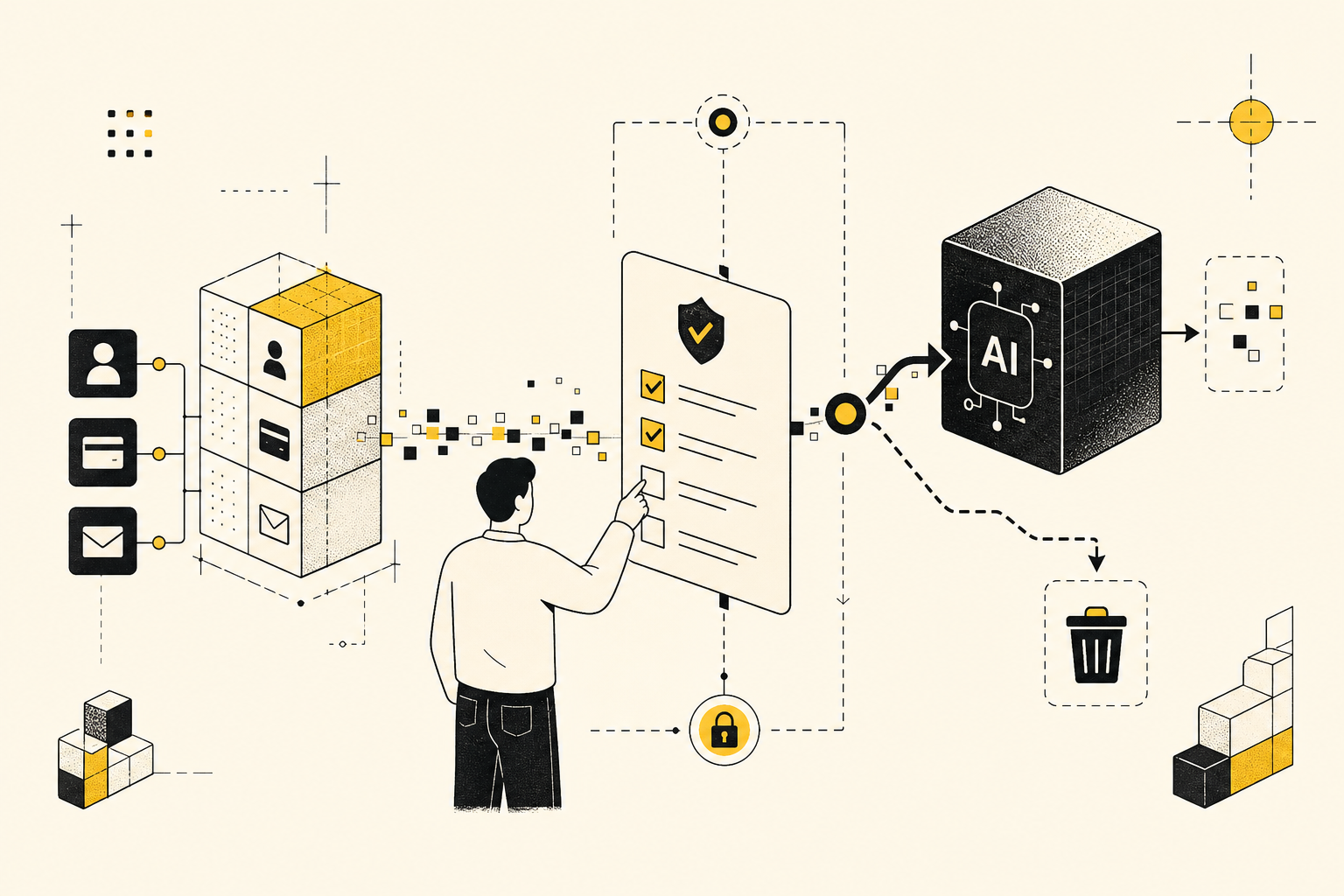
More information is not automatically better. Pass what the receiving person needs to handle the request, and avoid adding unrelated customer details to a handoff note. Think about who can access the note and transcript, how long they are retained, and whether your process follows the privacy and data-handling requirements that apply to your business. Those requirements depend on the information and context involved; this checklist is not a substitute for reviewing them.
Nor does every support setup need a complex routing design. A small business might begin with one monitored queue, a short handoff summary, clear availability messaging, and a few multi-turn tests. The important thing is to verify the complete chain: context travels, someone owns the next response, and the customer understands what happens next.
The useful design standard is not “the AI escalates.” It is: after escalation, can a person take the next useful step without making the customer reconstruct the conversation? Treat that as an aim to test, not a promise every platform or staffing model can guarantee.
Sources
- “Hold on, I’ll connect you to a human agent”: Recipient design, repair, and their impact on progressivity in human-chatbot conversations — peer-reviewed study of text-based customer-service handovers.
- Hand off to a live agent — Microsoft Copilot Studio documentation on conversation transfer and context.
- Graceful Failure and Escalation — Microsoft AI Agent Evaluation Scenario Library.
- Managing conversation handoff and handback — Zendesk documentation on conversation ownership after handoff.