An AI feature can be online, responding quickly, and still be giving people answers that are wrong, incomplete, or risky. Uptime tells you whether the service is available. It does not tell you whether the feature is still doing the job you built it to do.
For a small team, monitoring does not have to start with a specialist platform or an automated scoring system. Start with the task the AI is supposed to complete, the consequences of getting it wrong, and a modest routine for checking real outcomes. The goal is not to inspect every interaction. It is to notice meaningful changes early enough to respond.
A working feature can still be failing
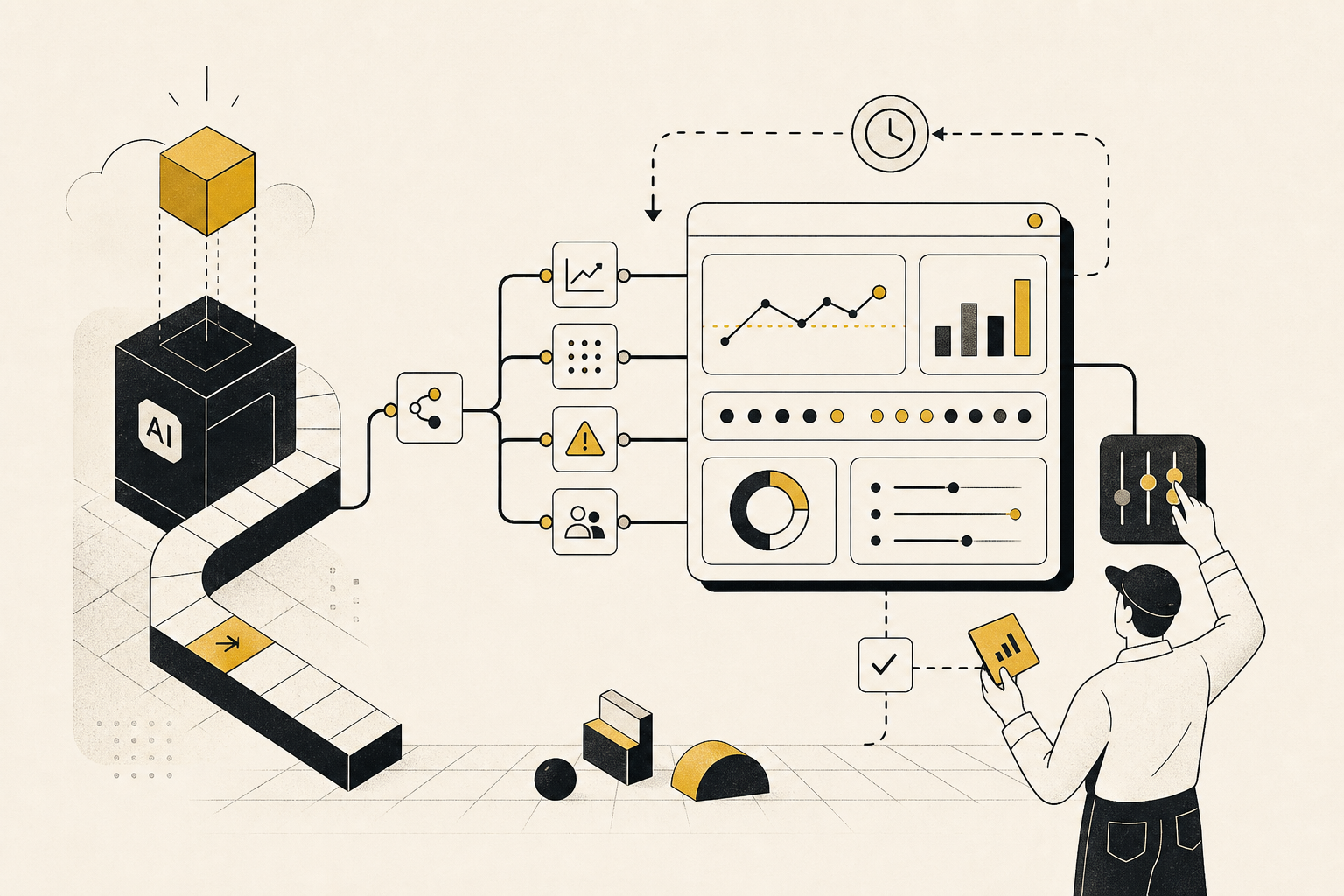
Operational monitoring asks questions such as: Is the feature responding? Has it become unusually slow? Are requests failing? These signals matter. If a customer-support assistant stops loading, that is a problem even if its answers are excellent when it works.
But service health and task quality are different. A feature may return a response every time while misunderstanding a request, omitting an important step, or sending users in circles. A normal uptime check will not catch that.
The right monitoring question is therefore not only “Is it running?” but “Is it still completing its intended task acceptably, and what happens when it does not?”
This is different from testing a prompt or model change before release. Pre-release tests help you decide whether a change is ready to ship. Post-launch monitoring checks what happens with real requests, real workflows, and changing conditions after release.
NIST’s AI Risk Management Framework calls for production monitoring, feedback processes, and planning for post-deployment monitoring and incident response. A 2026 NIST report describes the deployed-AI monitoring landscape as fragmented and points to challenges including detecting performance degradation, fragmented logging, and the effort involved in collecting and assessing user feedback. Those are not reasons to build a large monitoring system before you can begin. They are reasons to make the first checks deliberate.
Choose signals that match the feature
There is no universal metric that tells you whether every AI feature is good. A useful measure for a draft-writing tool may be irrelevant for a system that routes customer requests. Choose signals based on the task and the cost of a mistake.
Consider three categories:
- Operational signals: Is the feature available? Are requests failing or taking longer? Are there unusual increases in usage or cost? These can flag a service or workflow change, but they do not prove that outputs are useful.
- Correction and escalation signals: Are users repeatedly rephrasing requests, editing generated work heavily, asking a person to take over, or reporting a problem? Such behaviour can indicate friction or poor results. It can also have other explanations, so treat it as a clue to investigate.
- Task-outcome signals: Did the feature complete the job it was meant to do? For a tool that drafts replies, that might mean the draft was usable with limited correction. For a tool that categorizes requests, it might mean the request reached the right destination. For a tool that extracts information, it might mean the needed fields were present and accurate.
A signal is most valuable when you can explain what it means for this particular feature. “People clicked thumbs down” is less informative than knowing which task they were trying to complete and whether they had to redo the work. Likewise, a low failure rate says little about quality if failures are hard to report.
Write down one plain-language definition of an acceptable outcome. For example: “The assistant gives a relevant answer using the approved support information, and it hands off questions it cannot answer.” This gives reviewers something more concrete to assess than whether an answer sounds polished.
Create a lightweight review loop
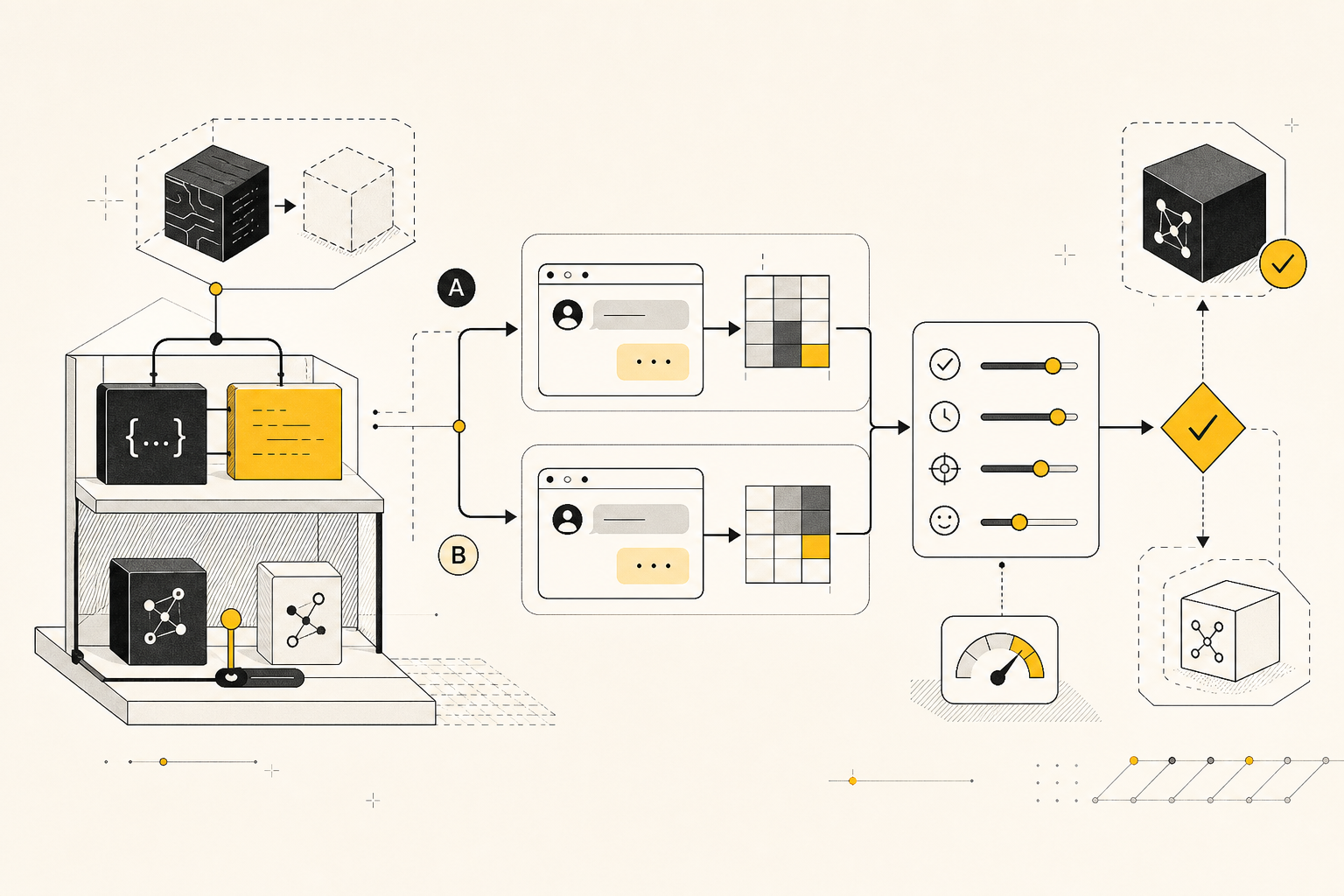
A manageable routine has four parts: define the outcome, inspect a sample, record enough context to investigate, and look for patterns.
1. Define what counts as acceptable. Identify the job, the important failure modes, and what should happen when the AI is uncertain or the task is outside its scope. If the consequences of error are high, the acceptable outcome may require a human check rather than an AI response alone.
2. Review a sample of real outcomes. Look at a mix of ordinary interactions and cases that have warning signs: user complaints, corrections, handoffs, abandoned tasks, or technical errors. A small sample will not prove that every output is correct, and it may miss rare but serious failures. It can still help you spot recurring problems before you have a larger evaluation process.
Google Cloud’s guidance on operating generative AI applications describes production-output evaluation and direct user feedback as monitoring approaches, alongside operational measures such as latency. You do not need to adopt a particular tool to use the underlying idea: combine what the system reports with evidence from what users actually experience.
3. Record only context that helps explain the result. Depending on the feature and your privacy obligations, useful context might include the task type, time, workflow version, whether a person took over, and a short description of the issue. In some cases, a reviewed output or relevant input may be necessary to investigate; in others, a category or redacted excerpt may be enough. Do not assume you need to retain every prompt and response. Decide what you need, who can access it, and how long it should be kept.
4. Classify problems and look for repetition. Simple categories make review more useful: incorrect information, missing information, misunderstood request, unsuitable response, failure to hand off, or technical problem. Note when an issue began and whether it appears tied to a particular type of request or workflow change. One awkward answer may be an isolated miss. Similar failures across a task type may call for action.
The review cadence should fit how often the feature is used and what a failure could cost. A low-consequence internal drafting aid may need a lighter check than a customer-facing feature that can make commitments or influence important decisions. Assign someone to own the review; otherwise, feedback and warning signs can accumulate without a decision.
Decide what to do when a signal changes
A warning signal is a reason to investigate, not automatic proof that the AI has degraded. A rise in handoffs, for example, might reflect poor answers, a change in the kinds of questions users ask, or an intentional change to the workflow. Check the examples and context before deciding what is happening.
Then match the response to the pattern and the risk:
- Fix the underlying information or instructions when repeated problems have a clear cause, such as an outdated source or an unclear task boundary.
- Change the workflow when the AI needs a confirmation step, a clearer handoff, or a person to check certain kinds of answers.
- Narrow the feature’s scope when it performs acceptably for some requests but struggles with others. Make the boundary visible to users.
- Revert a recent change if the timing and reviewed examples suggest that an update introduced the problem.
- Limit or pause the feature when credible failures could cause significant harm and you cannot quickly make the workflow safe enough. This is a risk-based operational decision, not a universal rule for every error.
After a fix, watch whether the same problem continues and whether the change creates a new one. Keep this check focused on the observed issue and the intended task outcome; it does not require turning routine monitoring into a large technical project.
Keep monitoring proportionate
A useful minimum is a named owner, a clear definition of acceptable work, a few signals tied to the task, and a recurring review of selected outcomes. Add more automation or tooling if the volume, risk, or difficulty of investigating problems justifies it—not simply because the feature uses AI.
User ratings, support reports, and sampled reviews are imperfect. People do not report every bad answer, and a small sample can miss important cases. Treat these inputs as evidence to combine, not as a guarantee of quality.
The practical principle is simple: monitor both whether the feature is available and whether it is accomplishing its job. When the evidence points to a problem, investigate the pattern, consider who could be affected, and choose the smallest response that makes the feature acceptably safe and useful again.