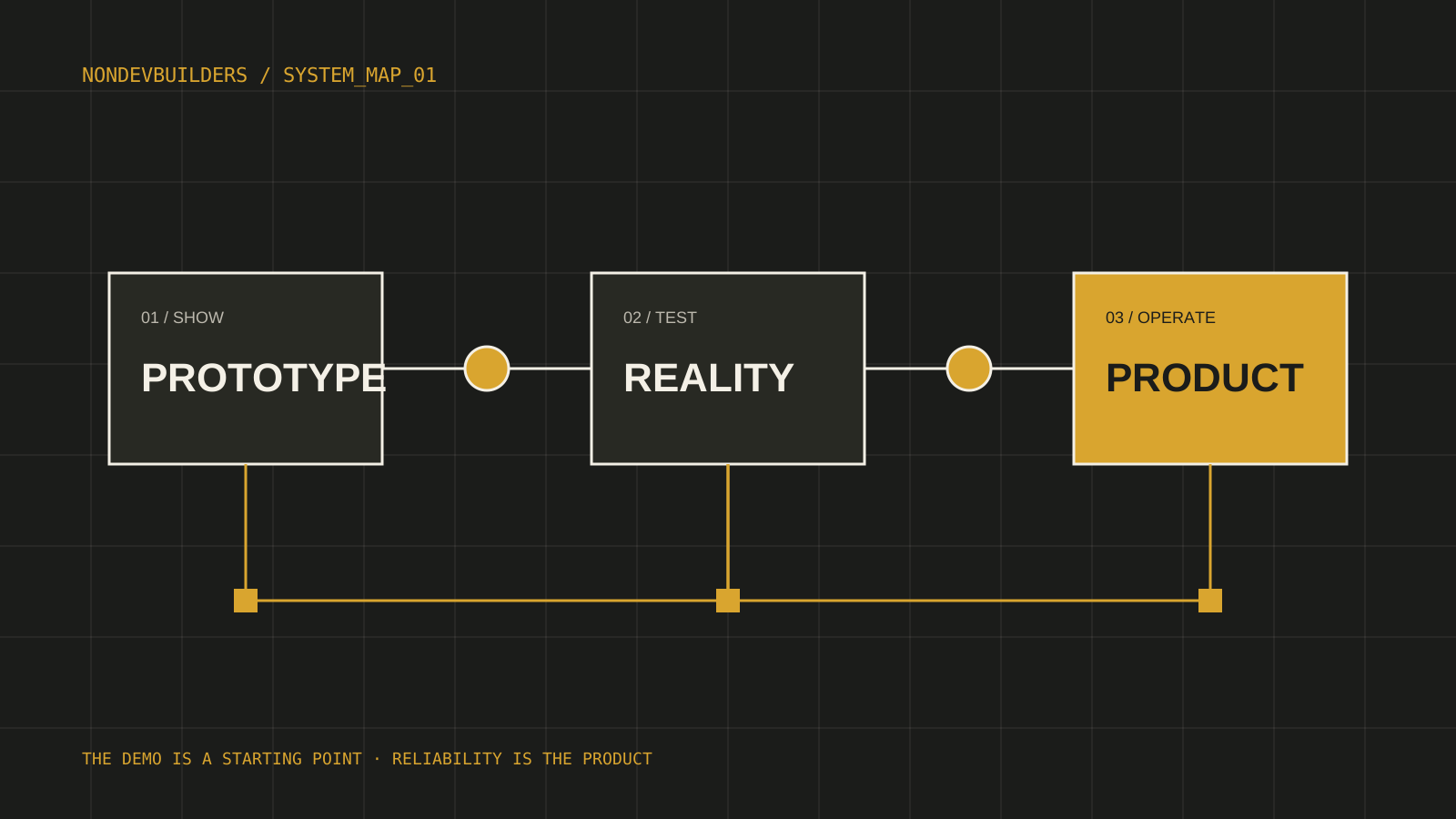
An AI prototype can make an idea feel real in an afternoon. You describe what you want, connect a few tools, and watch a system summarize a document, answer a question, or draft a response. It may be rough, but it works well enough to show what the product could become.
Then other people start using it.
They ask questions you did not anticipate. They provide incomplete information, use unfamiliar language, or expect the system to remember something it has forgotten. The answer that looked impressive in a demo turns out to be inconsistent. Suddenly, the task is no longer to make AI do something interesting. It is to make a product people can safely and confidently depend on.
That gap is larger than it first appears. A prototype demonstrates possibility. A reliable product has to handle variation.
A demo proves the happy path
A prototype usually shows a carefully chosen example: the right input, a clear request, and an output that makes the idea easy to understand. That is useful. It helps a builder test whether a concept is worth pursuing and gives others something concrete to react to.
But the happy path is only one version of reality.
A document assistant might perform well when the uploaded file is short and neatly formatted, then struggle with a scanned page or a document that mixes several topics. A customer-support tool might draft a sensible response to a straightforward question but mishandle a complaint, a refund request, or an ambiguous policy. The product’s quality depends not just on what it can do in the best case, but on what happens when the input is unclear or the answer is uncertain.
This is not unique to AI. Any product needs to cope with real use. But AI systems can produce fluent answers even when they are wrong, incomplete, or based on a misunderstanding. A polished response can make a weak result look more reliable than it is.
“Works” needs a more precise meaning
When building a prototype, “it works” often means that the system produced a useful result at least once. For a product, the question is different: how often does it work, for whom, and what happens when it does not?
A dependable product needs a clear boundary around its job. It should be possible to explain what it is expected to do, what information it needs, and which situations are outside its scope. Without that boundary, every unusual request becomes a potential failure—and it may be difficult to tell whether the system has failed at all.
Consider an AI tool that turns meeting notes into action items. A prototype might identify tasks from a sample set of notes. A product needs to make decisions about less tidy cases: Is a suggestion an action item or just an idea? Who is responsible if no owner is named? Should the system guess a due date, leave it blank, or ask the user? The answers are product decisions, not merely technical details.
Clear expectations also help users. They need to know whether the system is offering a draft for review or taking an action on their behalf. A tool that makes uncertainty visible is often more useful than one that presents every output with the same confidence.
Reliability is made of more than the AI model
It is tempting to treat the model as the whole product. In practice, the model is one part of a system that also includes the information it receives, the instructions it follows, the software around it, and the process for handling its output.
A useful answer can depend on whether the system has access to the right source material. If documents are outdated, incomplete, or hard to search, a capable model may still produce a poor response. If the user’s request lacks important context, the system may need to ask a question instead of filling in the gaps. If an answer will trigger a consequential action, a person may need to approve it first.
The surrounding workflow matters, too. What happens when a file cannot be read? Can a user correct a mistake? Is there a clear way to report a problem? If the AI service is unavailable, does the rest of the product fail, or can the user still complete the task another way?
These questions are easy to overlook in a demo because the builder can quietly work around problems. A dependable product cannot rely on the builder being present to interpret the input, spot a bad answer, or explain what to do next.
The uncomfortable work begins after the first success
Once a prototype attracts interest, the next step is not necessarily to add more features. It is to discover where the system breaks.
That means testing with varied examples, not only the ones that make the product look good. Try incomplete requests, conflicting information, long inputs, unusual wording, and cases where the right answer is to say “I don’t know.” Ask someone unfamiliar with the product to use it without coaching. Note not just whether an answer is wrong, but whether a user could recognize that it is wrong.
For important tasks, keep examples of expected results and use them when making changes. This does not require a sophisticated testing setup at the beginning. A simple collection of real or realistic cases can reveal whether a new instruction, model, or workflow has improved one situation while damaging another.
It also helps to separate different kinds of failure. Did the system misunderstand the request? Was the relevant information missing? Was the answer reasonable but too hard to use? Did the product fail to explain its limits? Different problems call for different fixes. Changing the AI instructions will not repair a confusing interface or an outdated source document.
Decide where a person belongs
Adding human review does not mean the AI has failed. It can be a sensible part of the product design.
For a low-stakes task, users may be comfortable editing an imperfect draft. For a decision that affects money, access, health, or legal obligations, the product may need stronger safeguards and qualified human oversight. The right balance depends on what the product does and what a mistake could cost.
A useful early version can limit its scope, require confirmation before taking action, or route uncertain cases to a person. Those choices may make the product seem less autonomous, but they can make it more trustworthy. Automation is valuable when it removes effort without concealing risk.
Build confidence in stages
A practical way to move from demo to product is to narrow the first version. Choose one user, one recurring problem, and a small set of situations the product must handle well. Define what a good result looks like and what the system should do when it cannot provide one.
Then observe actual use. Where do people hesitate? What do they correct? Which requests fall outside the intended scope? Use those observations to improve the product before expanding it. As usage grows, pay attention to whether the information, costs, response times, and support needs remain manageable. A feature that works for a handful of examples may behave differently when the inputs and users become less predictable.
The goal is not to eliminate every mistake before launch. That is rarely realistic. The goal is to understand the important risks, make failures easier to detect and recover from, and avoid promising more than the product can reliably deliver.
AI makes it faster to demonstrate what might be possible. It does not remove the work of deciding what should happen in ordinary, messy use. The distance between a compelling prototype and a dependable product is filled with boundaries, testing, workflow choices, and careful attention to failure. That work is less visible than a clever demo, but it is what turns a promising idea into something people can use with confidence.